This post is also available as a podcast: Podcast #006: Bondage for Beginners

It seems like there’s a lot of interest in bondage these days, and many couples are experimenting with stuff they never would have thought of before. If you’ve never tried bondage you may be wondering what the big deal is — why would anyone want to be restrained during sex? Well, we know nothing about the BDSM “scene” so we can’t speak very broadly, but we can tell you in one word why Sexy Corte and I periodically enjoy adding some light bondage to our sexy time: vulnerability.

To understand bondage let’s talk first about the goal, then the methods, then why it’s fun. The goal is simple: voluntarily restrain one spouse to enhance his or her vulnerability and submission. It seems most common for the wife to be restrained, but I’ve had Sexy Corte tie me down and tease me and it was lots of fun. Usually though, it’s me restraining her. The purpose of the restraint is to give control of your body to your spouse, not to be painful or uncomfortable. Submitting to bondage is a huge demonstration of trust to your spouse because it puts your naked body into their control and makes you supremely vulnerable. The bondage benefits both the dominant and the submissive spouse by giving the dominant person permission to act, and the submissive person permission to let go. The various toys described below are only used to accent the submission that has already been agreed to.

There are limitless methods of bondage, but they generally share a few common features.

  1. Nakedness. The submissive spouse will usually be restrained naked, or at least with her sexy bits exposed. Being naked with your spouse is already a big show of trust, and being restrained kicks it up a notch.
  2. Hand restraint. Often the submissive’s hands are restrained to prevent her from “protecting” herself. (I use quotes, because of course nothing should be happening against the submissive’s desires.) Hands can be restrained above the head (for example, tied to the headboard), behind the back, in front (for front-to-back positions), or even attached to the ankles. Hand restraint is probably the most common element of light bondage. Get those hands out of the way!
  3. Leg restraint. Legs, ankles, and knees can be restrained to keep the wife’s legs spread or to prevent movement in general. Leg restraint is an important element of position restraint and orgasm control.
  4. Head restraint. Head or neck restraint could be uncomfortable or even dangerous. This isn’t something we do.
  5. Eye restraint. Covering the submissive’s eyes can add another layer of trust and enhance vulnerability. Using a blindfold can really make extended foreplay exciting.
  6. Mouth restraint. Sometimes you just want to hear your spouse moan with pleasure instead of talk. Sometimes talking is distracting. Taking away the option to talk can be liberating for the person who is restrained. Always be sure that anyone whose mouth is covered can breathe freely and can signal a desire to stop.
  7. Position restraint. A combination of restraints can be used to hold the submissive spouse in a certain position, say for spanking. This can be critical for orgasm delay and multiple orgasms, which we’ll talk about below.

So what are the actual devices that can be used for bondage play? Almost anything you can imagine can be incorporated, but here are a few ideas. Each of these items probably deserves its own post!
liberator

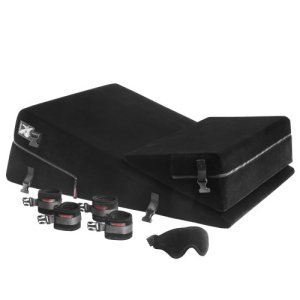
Wedge pillows. Sexy Corte and I enjoy these a lot for positioning, and they include attachments for…

Hand cuffs. We use some padded strips with velcro for closures and plastic clips that can be attached together or to the wedges. We’ve tried metal cuffs in the past, but they’re quite uncomfortable if you’re laying on them.

under-mattress

Under-the-mattress restraints. Looks complicated, but it’s not. The cuffs can be tucked under the mattress when not in use. These are especially useful if you don’t have a headboard suitable for tying to.

blindfold

Blindfold. If you want to improvise, use a neck tie or panties.

Gags can be similarly improvised, or you can buy one.

swing

Sex swing. We have one that can be quickly hung in a door frame and be used for a ton of positions. It’s easier than it looks.

spreader_bar

Spreader bar. Keeps those legs apart. Can be used in many positions, including standing, but isn’t great for missionary. I made ours with a wooden dowel and some eye screws.

pull-up-bar

Pull-up bar. These can be mounted in a door way and used as a restraint point for securing someone in a standing position. Also great for getting ripped.

an-unassuming-silver-bullet-vibrator-apparently-inspired-some-bawdy-attention-from-a-tsa-agent-who

Vibrator. There are many kinds, but we find the egg vibrator to be the most versatile. We buy cheap ones (around $7 from Amazon) and replace them once or twice a year when they wear out. We also keep rechargeable batteries charging in our bedroom. A wand vibrator can also be useful for longer duration games or when you need more reach.

Rope. Check out our intro to shibari for some awesome ideas!

karada

(Let me point out that you don’t actually need any toys! This post is getting long enough, so I won’t go into detail, but look forward to a future post on mental-only bondage.)

Finally, what’s fun about bondage anyway?

  1. Intimacy. Like I said at the beginning: the essence of bondage is vulnerability, and vulnerability is the key to intimacy. Bondage will teach you new things about your spouse’s mind and body. Bondage will let you explore new levels of sexual trust. Bondage exposes you to each other in amazing ways.
  2. Passion. Let’s face it: there can be something hot about dominating your spouse or submitting to his or her will. Maybe your sex is normally gentle and loving, and bondage lets you get a little rougher and more physically intense.
  3. Foreplay. Bondage requires time to execute, and all that time can be used as foreplay focused on the spouse being bound.
  4. Orgasm delay. Also known as teasing or edging. When the submissive spouse is free to move she can position her body just the right way to reach orgasm, and bondage can take away that ability and give control to the dominant spouse. It can be extremely difficult for a person to willingly back off from an orgasm when it’s close, but when using bondage the dominant spouse can pull back and keep the submissive spouse right on the edge without going over. This can make the orgasm incredibly powerful when it eventually comes.
  5. Multiple orgasms. After a woman orgasms her clitoris may become intensely sensitive, such that further stimulation is uncomfortable. If her hands and legs are free she may push the stimulation away for relief. However, if she is bound such that she can’t “protect” her clitoris her husband can continue with the stimulation and bring her to multiple orgasms. Sexy Corte describes these as an unending plateau of orgasm, rather than the peak and descent of the normal experience. They’re also quite exhausting, so this probably isn’t something you’ll do every day. As a husband, giving my wife multiple orgasms is one of my absolute favorite things.
  6. Fantasy. Bondage can be used as an element of fantasy or role-playing. It feels naughty, and once you’re in the naughty mindset you can free yourself to try some things that you normally wouldn’t. He’s the villain and she’s the kidnapped princess? She’s the super-spy and he’s the captured rogue agent who knows where the bomb is hidden?
  7. Exploration. Sometimes it’s hard to ask for our sexual desires, even when the marriage has good communication. Bondage can be an avenue for exploring desires that are difficult to speak out loud but perhaps easier to request non-verbally while in the moment. New experiences can break old habits, and you’re already feeling naughty, right?
  8. Escapism. Maybe it’s a minor form of dissociation, but bondage be a form of escapism from everyday life into a secret world of sex with your spouse.
  9. Novelty. Bondage introduces a myriad of new sexual options, new ways to play, new positions, new toys, and maybe even new desires.

In the end bondage should be fun and promote intimacy and vulnerability in your marriage. As always, enthusiasm and responsiveness will ensure that you get the most from your sexual experience.

Let us know what you think in the comments! What are you experiences? Do you have any suggestions to add?

If you liked this, please share it!

This post is also available as a podcast: Podcast #015: You Should Sleep Naked, Even in Winter

The answer to this question (at least sometimes) should be naked! Sleeping naked is very sexy. Not only does your skin feel amazing right up against your spouse’s, but feeling nice and silky sheets as you sleep is an added bonus. If your spouse is always wanting sex in the morning, but you have a hard time rousing yourself for it, sleeping naked is an excellent way to get yourself in the mood. Those last lucid dreams can turn very erotic, especially if you are naked snuggling. You are sure to wake up with a voracious sexual appetite!

I know depending on where you live that the cold winter months might not make sleeping naked sound very enticing. But, it only takes a few minutes to warm up underneath the sheets, and it is definitely worth that little time of discomfort. Plus it gives you a good excuse to snuggle up close to your spouse until you are warm. Sometimes if I get up in the middle of the night I like to crawl back in bed naked so that El Fury gets a surprise in the morning. He definitely wakes up faster! Especially with Valentine’s Day coming up, why not give your spouse a sexy surprise that morning?

If you liked this, please share it!

Sexy Corte and I like trying new positions, and we’ve found these sex position guides to be useful. (They definitely aren’t safe for work, but I didn’t see any actual nudity.)

When it comes to sexual positions, there are a few important things to remember.

  • Remember your purpose. Sex with your spouse should be fun, loving, and intimate. Husbands especially can get focused on accomplishing a position while forgetting the higher purpose.
  • Don’t get obsessed with novelty. Most couples have sex in the same few ways 90% of the time. That’s normal! It’s great to try new things, but it’s not a competition. Your friends and neighbors aren’t secretly out-doing you with insane new sex positions every night.
  • Combinations multiply your options. You can significantly increase your variety by using multiple positions in a single sex session.  A set of 10 positions can make 720 permutations if you use three positions per session!
  • Some of the positions you’ll see aren’t anatomically possible. I mean, seriously… some pictures have joints bending backwards, limbs attached at the wrong place, or holes implied where they simply don’t exist. Some of the things pictured are impossible for any human to accomplish. I think the artists and authors of these guides just need to fill space.
  • What has been will be again, what has been done will be done again; there is nothing new under the sun.” — Ecclesiastes 1:9. There aren’t really any new positions, just positions that are new to you. Humans have been having sex for a long time.
  • Don’t forget her orgasm. In our experience, most positions aren’t very stimulating for the wife. Don’t forget to take care of her needs. Ladies first, as we say.
  • Position guides make great foreplay. Sexy Corte and I sometimes email links to positions to each other during the day. Even if we don’t do anything fancy that night, the mental stimulation gets us in the mood!
  • Be careful! You can seriously injure yourself if you aren’t wise, especially husbands.

Do you have any more position guides that you’ve enjoyed? Any tips for exploring a variety of positions? Leave a comment!

If you liked this, please share it!

In response to some recent posts about the “Double Feature” a commentor raised the topic of using code words with your spouse to discuss sex in public or around your kids. For example, if Sexy Corte says “double feature” I’ll know what she means, but any other listener will simply think that we’re going to watch two movies. Here are some more code words… but to be honest, many of them will only fool children.

  • Nap time – Right… Mom and Dad are going upstairs to “take a nap”. It fools our kids while they nap or watch TV, but I wouldn’t try it when our parents are visiting.
  • Ruins – Some of our favorite times have been in ruins. When we’re feeling frisky we might say “this place looks pretty old, don’t you think?”
  • Get ice cream – This is what we call it when we drop our kids off with a friend while we go on a date. If we “get some ice cream” after dinner, well, it’s not ice cream.
  • That’s what she said – Ok, it’s a corny joke, but our kids don’t get it yet and it definitely turns our minds to sexy thoughts.
  • Hangry – Originally it meant I’m so hungry that I’m angry, but sometimes we mean horny instead.

What about you? What code words do you use with your spouse? We promise we won’t tell anyone.

If you liked this, please share it!

A little while ago El Fury did a post on How to Help Your Wife Orgasm. I think he made all great points, but there is one thing I would add. Time of day. This can also link back to communication, but I think it’s important to mention. Time of day has become a big factor for me with when I orgasm, especially with whatever season of life we are in. When El Fury and I were first married and had fewer commitments, this was much less of an issue. Anytime was pretty much the best time.

This changed significantly when kids got thrown in the mix. We still kept our sexy time routine, but since it takes much longer for me to orgasm, it especially impacted my schedule. It’s hard to be almost there and be able to finish when a baby cry starts blaring through a monitor! If something like that starts happening regularly, it can become pretty sexually frustrating. When you have a big adjustment like kids, career, etc. in life it’s important to also adjust your sex routine to make sure both spouses are getting the amount of sexual satisfaction they want.

Here are some different ways that we have adjusted our schedules to allow enough time for me to orgasm.

1. Set an alarm for snuggling and/or sex in the morning. If you are too sleepy, even just having that extra time to snuggle in the morning is a great way to start the day.

2. If you have kids that nap, get in the bedroom as soon as they go to sleep. As they start getting older, you can try to enforce “quiet time” so you can still get some time alone.

3. Set bedtime schedules and stick to them. Your marriage needs time alone and if you are anything like us, this time is best the few hours we have together after the kids go to bed. We fiercely guard bedtimes.

4. Have sex first. Right now in our season of life, I have the most energy right after the kids go to bed. This is when I have majority of my orgasms. I love it when we have sex, then go play a board game or watch TV. If we wait to have sex until we are both ready for bed and about to fall asleep, I am usually wiped from the day and not as much in the mood to orgasm.

As our kids get older and bedtimes change we have had to make periodic adjustments. Pay attention and figure out when you have the most energy in the day and are feeling the most sexy. Then communicate that with your spouse and make it a goal to have sex at that time. Your husband wants to give you an orgasm so help him figure out when is the best time to do that.


If you liked this, please share it!

This post is also available as a podcast: Podcast #004: The Importance of Sexual Responsiveness

In our recent post about the importance of enthusiasm we briefly mentioned responsiveness and promised a follow-up post, so here it goes. All aspects of sexual enthusiasm are valuable to cultivate with your spouse, but sexual responsiveness is critical for creating exciting, pleasurable, and memorable sexual encounters. What do we mean by sexual responsiveness? Basically, sexual responsiveness is verbal or non-verbal communication with your spouse during sex that demonstrates how much you’re enjoying what your spouse is doing right then. Whichever spouse is receiving/submissive at the moment should be sexually responsive to the actions of the giving/dominant spouse. These roles may swap once or more during a single encounter, so pay attention. For example, if you are receiving oral sex you should be the one responding.

In this post we will first discuss why sexual responsiveness is important and then describe some methods for being responsive.

So, why is sexual responsiveness important?

  1. Your response is your spouse’s reward! If your spouse is pleasuring you sexually, your response tells them that they’re being successful and that you appreciate their effort. If your spouse is going down on you and you’re silent, you may as well be checking your text messages or falling asleep as far as they can tell. We think the need for affirmation is especially strong for husbands — wives, it thrills your husbands when you moan and squirm!
  2. Your response leads to better sex. Your spouse wants to please you, so give them some hints! Your response should help your spouse learn to pleasure you the way you want.
  3. Your response heightens your own arousal. Responsiveness creates a feedback loop in your own body and brain. When you respond to your spouse you’re also pulling yourself deeper into the moment.
  4. Your response creates engagement. Do you want to feel more emotionally connected during sex? Be more responsive to your spouse. Being responsive helps keep both people in the moment, engaged with each other, and prevents distraction. It’s harder for your mind to wander to your to-do list if you are focused on your response to your spouse.
  5. Your response is critical when you’re near orgasm. This is particularly true for wives: when you’re close to orgasm, make sure your husband knows it. In order to climax you may need your husband to keep doing the same exact thing for just a few more seconds, so tell him!
  6. Your response leads to intimacy. What’s more intimate than crying out your spouse’s name when you climax? When you’re sexually responsive to your spouse you’re sharing the most personal, internal details about yourself, private knowledge about your secret inner workings that no one else gets to experience. If you’re shy about being overtly responsive then work intentionally to overcome that barrier and share yourself more fully with your spouse.
  7. Your response leads to great foreplay later. “It felt so amazing when you did XYZ… will you do that to me again later?”
  8. Your response is fun! Loud, boisterous, intimate sex is way more fun than quiet, inhibited, distracted sex.

What does sexual responsiveness look like? How do you become more responsive to your spouse? We’re glad you asked!

  1. Verbal. Call us old-fashioned, but talking is one of the best ways to respond to your spouse sexually! “More”, “faster”, “slower”, “don’t stop”, “yes!”, “almost there”, “keep doing that”, “you feel so big”, “I love being inside you”, “you’re driving me crazy”, “I need you inside me”. Talk dirty.
  2. Your spouse’s name. Yelling out your spouse’s name is a special kind of verbal responsiveness that your spouse will certainly enjoy, especially if you cry out while you’re climaxing.
  3. Moaning. For when it feels too good to put into words. Moans, cries, groans, “oh!”, “ah!”, and so forth. If you’re shy you might be thinking that these sounds will seem overly dramatic or fake, but trust us, your spouse will not laugh at you. If your spouse isn’t used to your moaning it might push them right over the edge of their own orgasm.
  4. Eye contact. Instead of closing your eyes and disappearing into your own head, keep your eyes open and maintain eye contact. This is especially sexy during initial penetration or orgasm.
  5. Kissing. Kissing during sex is always great. Let your spouse feel your reaction to pleasure through your lips and tongue.
  6. Hands. Clutch your spouse with your hands when you’re in the throes of pleasure. Tighten your grip. Interlace fingers with your spouse. Gently use your fingernails. Squeeze, fondle, pull.
  7. Legs. Similar to using your hands… grab your spouse with your legs. Tighten your grip.
  8. Penetration. Push, pull, grasp, or whatever is appropriate to deepen the penetration. Wife, it will drive your husband crazy if you show him that you need him deeper inside you.
  9. Writhing. Wiggle and writhe while you moan. Make sure your spouse knows you’re wiggling from pleasure and not discomfort! When pleasure is extremely strong this writhing will happen naturally, which is why incorporating some light bondage into your sex play can be fun and functional.
  10. Changing speeds. Going faster, slower, or even pausing can indicate your pleasure. A husband might need to hold still for a few moments to delay his orgasm, or a wife might need to stop moving to get herself over the edge. It’s important to use additional cues so that your spouse knows why you’re changing speeds.
  11. Skin contact. Adjust your position to increase skin contact, including arms, legs, and breasts.
  12. Bury your face. Nuzzle your face into your spouse’s neck, breasts, hair, or whatever is handy. This can be especially sexy during your climax, and can also help muffle your cries if you have kids in the house!

There are our tips for being sexually responsive. What do you think? What works for you in your marriage? Leave a comment and share your ideas with the rest of us.

If you liked this, please share it!

This post is also available as a podcast: Podcast #003: The Importance of Enthusiasm

We’ve been promising to write about enthusiasm for a while, but we’ve been having trouble wrapping our heads completely around it. Basically, our opinion is that enthusiasm is more important than any other single behavior when it comes to having great sex. [Tweet this] We know that’s a bold claim, but let’s see if we can convince you.

So what is enthusiasm? Our favorite definition is “lively interest”. Both of those words are important. I should be interested in sex with my spouse. I should think about it, plan for it, pursue it. Sex with my spouse should be one of my favorite hobbies. And my interest should be lively: active, self-motivated, dynamic.

What does enthusiasm look like? Enthusiasm for sex with your spouse isn’t just important while you’re having sex — it encompasses a lot of behaviors.

  1. Saying yes. Pretty basic, but it’s a lot better than when your spouse tells you no! As we’ve written before, yes should be the default answer when it comes to sex with your spouse. [Tweet this] There may be a reason to say no for a moment, but we’ll go out on a limb and suggest that the answer should be yes at least 90% of the time. Just like with your other hobbies, you find a way to say yes when you’re invited.
  2. Communication. Enthusiastic spouses tell each other what they like, what they want, and what they need. You can’t wait to talk to your friends about your other hobbies, right? Don’t make your spouse drag it out of you — offer your thoughts and opinions. Be eager to listen to your spouse’s desires. Be as explicit and specific as necessary! Tell your spouse exactly what you want. These conversations can take place any time, but they seem ideal for when you aren’t in the middle of sex or immediately before or after. Make some time to talk during the day. (Which may lead to sex.)
  3. Improvement. Enthusiasm means you want to be the best sex your spouse has ever had. This is the part where you follow-through on the communication. If your wife wants you to tickle her g-spot more before penetration, you can’t wait to please her. If your husband wants a quickie, shut the door and drop your panties. Your spouse has told you what they want, so hop to it! And not just the one time — be a student of your spouse and incorporate your new knowledge into your permanent expertise. When you’re invested in a hobby you work at it to improve, right? You read about it, study it, test out new ideas, and learn from experience. Sex with your spouse should be the same way.
  4. Responsiveness. Now we’re getting to what enthusiasm looks like during sex. When you’re having sex, be there, in the moment. Be fully engaged. Look your husband in the eyes and moan when he enters you. Tell your wife how amazing she looks when she rides you. Responsiveness at any given moment is mostly the responsibility of the submissive, receiving partner. The person in the receiving role may stay the same throughout a sexual encounter, or it may change several times before you’re done. The point of responsiveness is that the receiver needs to demonstrate their pleasure to the dominant, giving partner. Don’t just lay there like a rug while your spouse goes to town. If you want your spouse to improve, give them the feedback they need! It’s especially important to clearly communicate to your partner when you’re close, and when you’re having an orgasm. The topic probably deserves its own post, but here are a few ways to be responsive: talking (“more!”, “yes!”, “almost there!”); kissing; moaning; using your spouse’s name; clutching with your hands or legs; connecting with your eyes; writhing with your hips; deepening penetration; or changing speed.
  5. Experimentation. This goes for before and during sex: be open to new ideas, and don’t get frustrated if something doesn’t work. Sure, every couple has a repertoire of reliable positions that are guaranteed to please both spouses, and that’s great. You don’t have to try something new every time; most of the time your basic method is just fine. But when your spouse suggests something new, say yes! Maybe it won’t work, but don’t pre-judge it; chances are, your spouse has been working up the nerve to ask you for a while. When you say yes, don’t wince or roll your eyes, even if you’re skeptical. Don’t use the dreaded, “eh, if you want to” line either. That’s resignation, not enthusiasm. When your spouse wants to try something new with you, consider it a gift. This is an experience they’ve planned just for you and no one else in the world. Later (but not immediately afterwards), the two of you can talk about it and decide if its something you want to do sometimes/always/never. Just remember: unlike other hobbies, you’re the only appropriate sexual partner for your spouse; if you say no, that closes a door on your spouse’s desire forever.
  6. Fun. Why so glum, chum? Sex is serious business, but it should also be seriously fun. Sex with your spouse is your own private amusement park! Ride all the rides. Eat everything in sight. Laugh, joke, tickle, wrestle, tease, snuggle, play! Sex isn’t just about having babies and orgasms. What do you like best about your other hobbies? Find ways to incorporate those qualities into your sex life. For example, Sexy Corte and I like playing games, so we created Sexy Adult Jenga and Naked Marco Polo. No matter what you enjoy, you will likely be able to bring some aspects of your hobby-personality into your sex life. When your spouse introduces these interests into your sexual encounters, remember to say yes!
  7. Orgasm. Right, so sex isn’t only about orgasms, but let’s face it: orgasms are awesome. You don’t need to have an orgasm every time you have sex, but you should have an orgasm as often as you want to — and so should your spouse. Enthusiasm is hungering for an orgasm from your spouse, and craving an orgasm for your spouse. [Tweet thisMen can be very goal-oriented and focus excessively on the orgasm, so husband, make sure to listen to what your wife wants in the moment. Wife, your husband can’t read your mind, so make sure you are as responsive as possible.

Whew! That’s a long post; I hope it makes sense. If you want to kick your love life up a notch, foster some enthusiasm for sex. Please leave a comment and tell us your perspective on enthusiasm!

If you liked this, please share it!

Athol Kay at Married Man Sex Life has a post up about using active listening to connect with your wife while she decompresses from her day. This is a part of something I call emotional undressing. Just like you have to take your clothes off, you also have to undress your emotions if you’re going to connect sexually. Athol’s point is pretty simple:

Most women have a need to verbally decompress their day. Which is a fancy way of saying they need to talk when they come from work, or you come home from work when they’ve been home all day. Women tend to be more emotionally fluid than men, and it can often seem to the guy like he’s been dropped into a verbal puking of half a dozen emotions and disconnected storylines. This is just her  clearing her daily event cache. […]

The actual solution is to do what I call “Booing the Villians and Cheering the Heroes”. Which is to say you treat it something like watching a TV show with a bag of popcorn, and simply enjoy the show. When good things happen you say “woo-hoo”, when bad things happen you say “that sucks”. Her friend does something good in her story, say “she’s awesome”, and when some bitch does her bitch thing, say “that bitch”.

And some great tips from the comments:

  • ”That must have been {hard/difficult/frustrating/a relief/description of situation}”
  • ”You must have felt {emotion}”
  • ”Tell me more.”

The need to decompress isn’t limited to women — men need to decompress too, even though it may look different. Since women tend to be more relational then men, it’s not surprising that they decompress by discussing their relationships. Men tend to be more goal-oriented, which means that we decompress by tying up the loose ends of our daily tasks. It takes effort to switch gears when we’re focused on work (or a project), and it’s frustrating to leave a job undone when a good stopping point is in sight.

In the micro, when we get home from work we men tend to have rituals we like to complete before we’re ready to fully engage with our family. For example, I take off my shoes, change into comfy clothes, and wash my face and hands. I love to see my wife and kids when I walk in the door, but I’m not ready to settle in with them until I get a few things done. Even completing these minor tasks helps clear my brain and lets me switch into family mode.

In general, women decompress themselves by discussing their relationships, and men decompress themselves by checking off their to-do list.

Ultimately what we’re talking about here is context switching, and this decompression frees us up to go to the next thing. If you’ve been reading tips on the internet for enhancing the romance in your marriage, most of the tips you’ll find are techniques for assisting you and your spouse to switch into a sexy context. Foreplay is certainly a part of this, but it’s really one of the last steps. The first steps happen when you and your spouse decompress.

If you can identify the steps you have (unconsciously) taken to emotionally undress when you have had a mutually pleasing sexual encounter with your spouse, you can later recreate those steps to assist with a context switch in a more difficult circumstance. Don’t just examine the 10 minutes before you have sex, but consider all your interactions with your spouse over the past 24 hours. Look for the times that your spouse was definitely not in the mood for sex, and then think about what happened between then and your spouse’s orgasm. This whole process is the emotional undressing.

If you liked this, please share it!

This post is also available as a podcast: Podcast #014: A Few Sexy Halloween Games

If you’ve got kids then you know how you’re spending your Halloween: trick-or-treating! But after the kids are in bed you can still make some time to enjoy the holiday with your spouse. Maybe your wife (or husband!) has a sexy costume she can put on in private, or maybe you can play a spooky game together to get your blood flowing. Here are some ideas:

  • Scavenger hunt: Make a list of spooky shapes and then use water-soluble markers to draw them all over your bodies. Each person looks for the shapes on their spouse. Bonus points: both spouses scour each other at the same time, and whoever finds them all first wins!
  • Mummy wrap: The age-old childrens’ classic, except your spouse isn’t wearing anything underneath the toilet paper. Your spouse can wrap you, or you can wrap yourself up and your spouse can do the unwrapping. Bonus points: wrap or unwrap without using your hands.
  • Tell scary stories: Snuggle together under the sheets with a flashlight and tell some scary stories. You can take turns telling stories, or do it “popcorn”-style where each person talks for a minute or so and then the other takes over developing the same story. Bonus points: Do it naked, obviously!
  • Fortune teller: Nothing occult here, don’t worry. Put the pieces from your Sexy Adult Jenga game in a bag and draw them throughout the day to tell your spouse’s fortune: how he or she is going to get lucky later that night. Each person draw a piece once per hour — him at the top of the hour, and her on the halfs. If you’re not together, text the results to each other. Bonus points: follow the instructions when you draw the piece.
  • Role-playing: Halloween is a great time to do some role-playing, even if you don’t have the “right” costumes. Cop and robber? Haunted closet? Last day on earth? Bonus points: make it something spooky.

What do you and your spouse do to spice up your Halloween?

If you liked this, please share it!

Jay Dee has conducted a survey about wives’ orgasm experiences and posted the results as a nifty infographic. After the infographic there are a bunch of tips from husbands and wives on how to help the wife to orgasm. Maybe Sexy Corte will share her perspective, but here are my tips:

  • Relax! Don’t pressure yourself or each other. Men tend to be very goal-oriented, and it can be frustrating to “fail” to give your wife an orgasm when you’re really trying your best. Usually men react in one of two ways: try even harder or give up. Well, some nights she just isn’t going to get there no matter what you do, and trying harder just ramps up the pressure on her. Sometimes the right answer is to give up for the night and just enjoy being intimate… but that doesn’t mean you should give up on her orgasms forever! If she isn’t going to get there tonight, make sure she gets lots of snuggles instead.
  • Communicate! Wives, you need to let your husband know what feels good to you. Most women can’t orgasm from intercourse alone, but penis-in-vagina is what feels good to a man. If you don’t tell him differently he’s going to assume that’s how you orgasm too. Be brave enough to ask him to use his mouth or fingers on you, and when it feels good let him know! Most husbands greatly desire to sexually please their wives, but we can’t read your minds. I’ve discovered that using words is one of the best ways to communicate! “Harder”, “Softer”, “Faster”, “Slower”, “Touch me here”, “More lube please”, “That feels amazing!”, etc.
  • Patience! Keep pursuing her orgasm, but do it low-key — it will happen when you both relax and let it happen. It takes a lot more energy and investment for a women to orgasm than for a man. If she’s tired, cranky, worried, sick, in pain, or distracted she may not want to put in the effort to have an orgasm. Husbands, you probably won’t be able to solve problems like those with a few minutes of foreplay. Wives, be patient with yourselves and your husbands. Your body is complicated! Don’t worry if it takes a while to figure it out. Enjoy your journey to the amusement park of orgasms!

man-woman_machine

If you liked this, please share it!